


Dozens of farmers yesterday protested in front of the Environmental Protection Administration (EPA) in Taipei against the Gaoping Great Lakes (高屏大湖) project as the case was being reviewed by the Environmental Impact Assessment (EIA) general assembly.
The Water Resources Agency’s cross-border water channeling project which aims to address water shortages by building five artificial lakes in a nearly 700 hectare area on the border of Pingtung County’s Ligang Township (里港) and Greater Kaohsiung’s Meinong District (美濃), has been heavily criticized by local farmers and environmental groups.
An EIA ad hoc meeting in January suggested two options for the general assembly: Allow the development of one lake first, then redo the assessment, or reject all development plans.
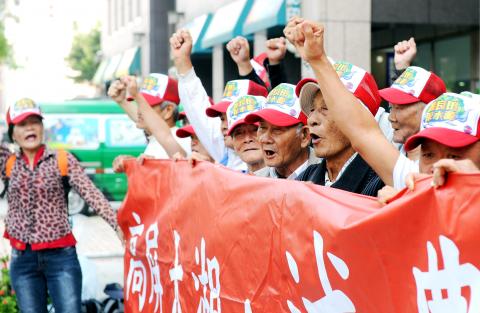
Photo: Lo Pei-der, Taipei Times
The protesters said spending more than NT$10 billion (US$337 million) on the project was a waste of money, as it would destroy good quality land used for growing high-yield green soybeans with a high export value, adding that water conservation could be achieved by simply improving the area’s tap water leakage rate.
“The area forms a natural pond whenever there is a typhoon, but I am concerned about flooding if dikes are erected for artificial lakes,” said a local resident surnamed Liang (梁), who lives near the site of the proposed develoment in Ligang.
Citizen of the Earth Taiwan executive director Lee Ken-cheng (李根政) said the Greater Kaohsiung and Pingtung County governments have proposed alternative solutions including water recycling from household and industrial wastewater, improvement of the Donggang Creek (東港溪) to increase water supply and improving tap water leakage rates, which could contribute to sustainable development.
Officials from the local governments said as the project’s data is incomplete and the necessity and urgency of the project is still undecided, the developer should provide an improved project plan.
The final decision made at the meeting yesterday was to reject the Water Resources Agency’s current proposal and to ask central and local governments to find alternative solutions for land use and water allocation, as well as conducting a comprehensive review of the necessity of the project.

UPGRADE: The Kang Ding-class frigate is replacing its Chaparall missiles with Tien Chien II and Hua Yang VLS, which would provide it with long-range, 360° air defense Taiwan plans to produce 1,200 to 1,376 Hai Chien II missiles (海劍二, Sea Sword II) — also known as TC-2N — to serve as the standard air defense system of the navy’s surface combatant fleet, a source said yesterday. Last week, the Hai Chien II, the naval version of the Tien Kung II missile (天劍二, Sky Sword II), completed a live-fire test in waters off the National Chungshan Institute of Science and Technology’s Jiupeng facility (九鵬) in Pingtung County’s Manjhou Township (滿州). The MIM72 Chaparral and other dated air defense missiles that currently arm Taiwanese ships have inadequate range to combat Chinese

REASONS FOR TRAVEL: An assistant professor said that proposed amendments to penalize drivers if they used drugs overseas would not deter people from traveling People who operate a motor vehicle under the influence of marijuana would have their driver’s license revoked, even if they used the substance while overseas, the Ministry of Transportation and Communications said yesterday, citing proposed amendments to the Road Traffic Management and Penalty Act (道路交通管理處罰條例). The amendments would also authorize the government to revoke the licenses of people determined to have used Category 1 or Category 2 narcotics, even if they were not operating a vehicle while under the influence of drugs, as well as ban them from taking the license test for three years, the ministry said. People aged 18 or

HEAVY WEATHER: Typhoon Jangmi is due to crash straight into the Ryukyus as airlines look to shift flights to larger aircraft or cancel flights to Okinawa entirely Taiwan’s international air carriers announced flight adjustments over the weekend as Typhoon Jangmi is forecast to hit the Ryukyu Islands today and tomorrow. The Central Weather Administration (CWA) upgraded Jangmi from a tropical storm to a typhoon at 8am yesterday, with the eye located 580km south of Naha city. It was moving north at 19kph. Today, China Airlines’ CI-120, CI-121, CI-122 and CI-123 flights between Taoyuan and Naha, Okinawa, have been canceled as well as CI-132 and CI-133 between Kaohsiung and Naha. EVA Air’s BR-112, BR-113, BR-186 and BR-185 flights between Taoyuan and Naha are also canceled. Low-cost carrier Tigerair Taiwan canceled IT-230,

Johanne Liou (劉喬安), a Taiwanese woman who shot to unwanted fame during the Sunflower movement protests in 2014, returned to Taiwan last night after being deported from the US. She is to stand trial in Taiwan for charges involving embezzlement, fraud and drug crimes. The Criminal Investigation Bureau (CIB) said it took her into custody at Taiwan Taoyuan International Airport and would first question her before transferring her to the New Taipei District Prosecutors’ Office. She was arrested upon disembarking a flight from San Francisco that landed shortly before 7pm. Liou absconded to the US in 2019 after jumping bail


 RSS
RSS